
Why Self-Mastery Comes First


The Truth That Few Will Discuss, Because It’s Not Glamorous Enough For the Ego
Self-mastery doesn’t belong to any religion, lineage, or tradition.
It’s a relationship with the self that must exist before belief can be safely held. When I speak about self-mastery, I will reiterate this frequently: it does not refer to any type of dogma or indoctrination, and it does not care what your spiritual path is, respectfully. Self-mastery is what precedes the truth that resonates with you.
At its core, self-mastery is the ability to meet your inner world honestly—without denial, fantasy, or self-betrayal. It is the slow work of healing the places where fear, unmet needs, longing, and unintegrated pain quietly steer your choices. Until those places are seen and tended, they do not disappear. They gain permanency and influence.
A person who has not cultivated inner mastery is easily moved—this isn’t because of weakness, really; it’s because parts of them are still searching to be met. That search can be exploited by power, ideology, intimacy, substances, spiritual experiences, or the promise of transcendence. What feels like a calling or destiny is often unrecognized hunger and unconscious desire.
Now, this can be dangerous territory. I’ve personally witnessed people lose their sanity in this space—believing their experiences to be sacred callings or revelations, when in reality, unhealed pain and intense longing warped their perception until they could no longer distinguish meaning from delusion.
As a Seer, I believe we’re living in times where this danger is growing exponentially worse. How do we save ourselves in this spiritual inversion and distortion?
This is why self-mastery is important for everyone, regardless of their beliefs.
It’s certainly why it matters for those who walk between worlds.
Psychonauts, magical practitioners, mystics, seekers, and even those who engage in transcendent prayer—anyone who works with altered states or shifting consciousness—they step into spaces where amplification occurs. Inner material does not stay quiet there. Longing becomes louder. The shadow blinds the seeker to Truth. Fear takes form. Desire presents itself as a revelation of divinity.
Without inner mastery, the mysteries do not purify—they magnify. You both see and are seen to greater degrees.
Many people enter these realms seeking healing or truth, completely unaware that their unexamined patterns accompany them. The psyche does not leave its wounds at the threshold. It carries them inward, for the portal is inward first, where the wounds are echoed back through archetype, image, sensation, and myth. What’s unresolved becomes convincing to the psyche. What’s fragmented can become authoritative and threatening. The unintegrated aspects of the Self can feel like an external force or divinity.
This is where self-mastery becomes a form of protection through discernment.
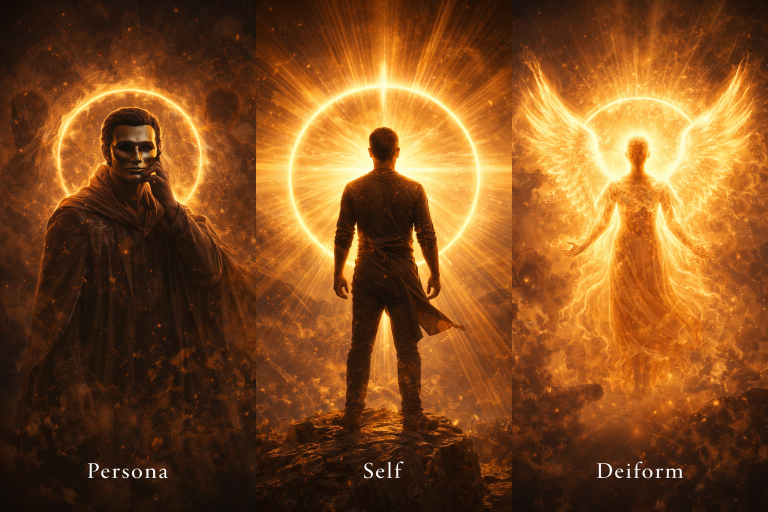
When the Self is grounded and integrated, it is far less susceptible to deception occurring on the external or internal. It recognizes the difference between intuition and compulsion, between symbol and literal truth, between guidance and projection. It doesn’t collapse into the experience of altered states, nor does it inflate because of it—it remains at the midpoint, the axis of “I do not fear, I do not need, I do not walk as a shadow self in the unknown. The only voice that guides me is the sovereign within.”
Inner mastery creates a stable center from which experience can be witnessed rather than obeyed. Until mastery is cultivated, we are often unknowingly obeying the hidden drives of the unconscious.
Understanding archetypes and symbolism is part of this work of self-mastery. It’s not wise to blindly inhabit archetypes; they are patterns that move through consciousness over time and with experience. When misunderstood, they can overtake the personality. When understood, they become intelligible forces that can be related to without submission.
Any proclamation of “I am…” followed by an archetypal identity is often a sign that the archetype has overtaken the personality. These pattern identifications tend to repeat until the work of self-mastery begins.
Likewise, the inner senses are very different from physical senses when exploring the inner or far reaches of consciousness. Inner senses do not speak in linear language, moral certainty, or fixed instruction—they must instead be decoded as they are timeless and broader in scope. They communicate through resonance, image, tension, and meaning that unfolds over time. The soul does not issue commands. It offers orientation and cohesion through a language very different from the many fragmented languages humans have invented.
This is why the macro cannot be approached with the logic of the fragmented micro.
Human language divides, labels, and fixes. The language of the soul integrates, gestures, and reveals gradually, slowly, as a devotion, and as the only way wisdom develops. When we mistake one language for the other, we either literalize the symbolic, confuse fantasy for the sacred, or dismiss the sacred as fantasy. These errors lead to confusion, and in some cases, harm.
Self-mastery teaches patience with these differences. It teaches restraint, humility, and responsibility for your own inner material. It requires that you become trustworthy to yourself before claiming authority in unseen spaces, for you hold a universe within you, although you’ve been taught to seek the answers outside of yourself.
True freedom is not found in how far consciousness can travel, but in how steadily it can return—intact, cohesive, and accountable.
Self-mastery is all about coherence, and from coherence, very little can enslave.
The goal is liberation, in the active sense, no matter where your consciousness chooses to explore.
As an added note: On your journey of self-mastery, let mastery speak for itself. You don’t need to announce authority when coherence is doing the work. The ego will want to scream from the rooftops—but trust me, it is better to keep silent as you understand exactly what you are experiencing in the far reaches.
Listen to the Podcast
This topic is also explored in audio form on the following platforms: