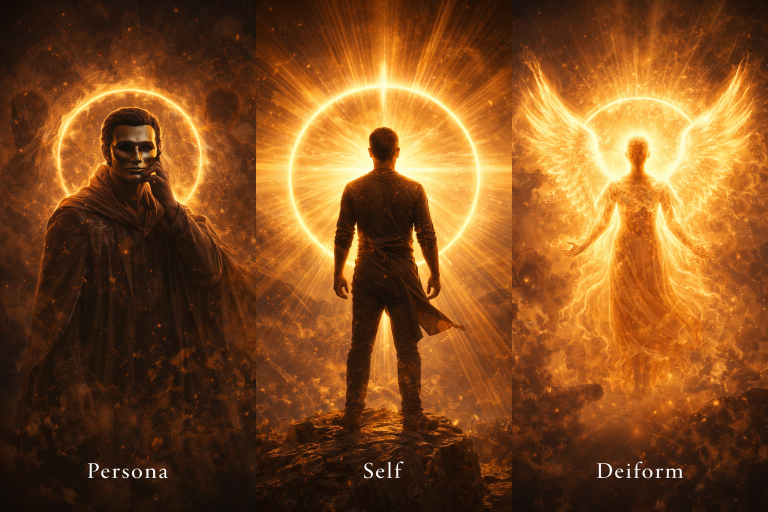

Three Questions


How Do You Know When You’re Ready for Self-Mastery?
That Feeling You Can’t Shake
So imagine this: your life is actually… fine. You’re showing up, doing what you need to do, maybe even crushing it by anyone else’s standards. You should feel good about that, right?
But you don’t.
And here’s the thing—you’re not depressed. You’re not really anxious. It just feels… off. Like something’s not quite right.
You can rest, but you don’t actually feel restored. You’ll try to distract yourself—scroll through your phone, watch something, stay busy—but the second you’re still again? That feeling comes right back.
You can explain your life to anyone who asks. You can justify every choice you’ve made, defend them really convincingly, even. And still, there’s this quiet resistance inside you.
You’re just not aligned.
That feeling? It has a name.
Dissonance.
Now, I’m not talking about cognitive dissonance—you know, when you’re holding two opposing ideas at the same time. This is deeper than that. Quieter. But so, so powerful.
This is existential dissonance. It’s that internal friction that shows up when the life you’re living doesn’t match the truth you’re now capable of seeing. It literally refuses to let you accept what’s no longer true for you anymore.
Life still functions. Your identity still performs its role. But something inside you has withdrawn its consent.
If this sounds familiar, these next questions are going to hit home.
Question One: Why Do I Keep Repeating This Pattern—Even When I Understand It?
This question comes up when your awareness has outpaced your habits.
You can see the pattern. You know what it’s costing you. And yet… you keep doing it anyway.
What’s happening is called fragmentation. Parts of your psyche are still running on these outdated survival scripts that don’t serve you anymore—or your authentic self. And those parts? They’re clawing to be free.
Question Two: How Much of What I Believe, Want, or Fear Is Actually Mine?
This is a big one.
Is this career actually right for me? Does this religion let me think freely, or am I just going through the motions? Why does this house, this car, this circle of friends feel so superficial and empty? Why am I the only one in my circles who seems to see past the surface narrative?
Have I outgrown my own life?
When you start asking these questions, you’re beginning to deprogram your mind.
Those beliefs you inherited? Those conditioned desires that led you around mindlessly? All those reflexive fears? They start to feel foreign. Like they’re not yours.
Your inner landscape feels crowded with voices that aren’t your own.
And this is where discernment becomes absolutely necessary. Because without it, you can’t have real agency.
Question Three: Why Do I Feel Disconnected From Myself Even When My Life Looks Fine?
This is the most subtle question, and honestly, the easiest one to ignore.
It reveals something important: you’re managing your life rather than actually living it. Rather than inhabiting it.
It’s not a crisis—it’s misalignment. You’ve adapted really well, but at the cost of coherence with who you really are.
What These Questions Really Mean
Here’s the thing—these questions aren’t asking you for answers.
They’re announcing that you’re ready for self-mastery. That you’re ready for devotion to your authentic self.
You’ve reached a point where unconscious coping doesn’t work anymore, but conscious authorship hasn’t quite begun yet.
You can sense that you can’t go back to who you were.
But you’re not yet living as the person you’re becoming.
THIS is when self-mastery actually begins. It’s not about discipline or control or self-improvement yet. That stuff comes later.
What’s present—and impossible to ignore—is this intolerance for inner dishonesty.
And immediate change? That’s not the answer to this kind of dissonance.
What it’s asking for is presence.
The willingness to stand still at the threshold and feel what’s true without rushing to fix it or resolve it. To stop abandoning your own inner knowing just for comfort, or certainty, or approval.
Self-mastery begins here because something within you is ready to be integrated.
My Own Moment at the Threshold
I remember my moment of existential dissonance so clearly—standing right at the edge of self-mastery, even though I didn’t have the language for it yet.
At the time, I was living in constant reaction. To people, to situations, to these emotional undercurrents that never seemed to settle. I felt like I could never rest. There was always conflict, always drama, and it felt endless.
Not because the world was particularly worse than usual, but because I wasn’t thinking my way through my life—I was reacting to it. Caught in these cycles and patterns, swept up in chaos and emotional tides that I didn’t know how to free myself from.
What rose in me first was this aversion. The way I was living didn’t feel honest anymore. Not in a moral sense, but in this deeply, deeply internal way.
I could feel where I was compromising myself just to keep things moving. And suddenly, those compromises became utterly intolerable.
At the same time, something unusual started happening in my awareness. I was watching myself—and the people around me—almost like I was outside my own body. Observing dynamics unfold with this clarity I hadn’t had before.
I could see obvious truths being ignored by everyone involved, myself included. And once I saw them? I couldn’t unsee them.
I reached this point where I couldn’t tolerate meaningless encounters anymore. Environments that were just loud for the sake of distraction. The world felt overwhelming, noisy, relentless.
And yet beneath all of it, I was straining to hear something much quieter—this voice within that was still soft, still developing, not yet strong enough to drown out everything else. I wasn’t fully guided by it at that point, but I could feel its presence. And I knew it mattered.
Being who I am, I didn’t try to suppress that feeling or explain it away. I turned toward it. I wanted to understand what this passion was that was rising inside me, what it was asking of me.
And when it began to unfurl? It was like every moment of my life suddenly arranged itself into a coherent story. Patterns became visible. Signs appeared everywhere. Experiences that once felt random or painful revealed their meaning.
I didn’t need to search outward for answers anymore, because they were abundant within me.
That’s when I understood: healing wasn’t about fixing myself or becoming someone else.
It was about unflinching devotion to self-love—the kind that refuses self-betrayal.
Everything I had once directed toward the world began to turn inward. And I started moving through life with this single, grounding question: how did I contribute to this moment, and how can I improve myself—only for myself?
Not to earn approval. Not to prove my worth. But to come into alignment with my own integrity.
And when I tell you that doors opened? It shifted the ground beneath me.
I took the reins of my own reality in a way that still feels hard to fully articulate. Because it had nothing to do with becoming rich, successful, or admired. It wasn’t about material gain at all.
What happened was the liberation of my soul.
And I can say without hesitation—there is nothing more valuable than that. Nothing.
If You’re Ready, You Already Know
If you’re ready, these words will resonate with you. Not because I have your answers, but because something in you is already listening.
I don’t carry solutions for anyone else’s life. I don’t do anything for you beyond offering language.
If my words activate anything, it’s only because that truth already lives within you—just waiting for your own devotion to inquiry to bring it into your consciousness.
YOU are what you’ve been seeking.