Archetypes Part 2: The Persona, the Self, and the Deiform

The Persona, the Self, and the Deiform
An Archetypal Model of Inner Development
Give yourself a break.
Human consciousness does not mature all at once.
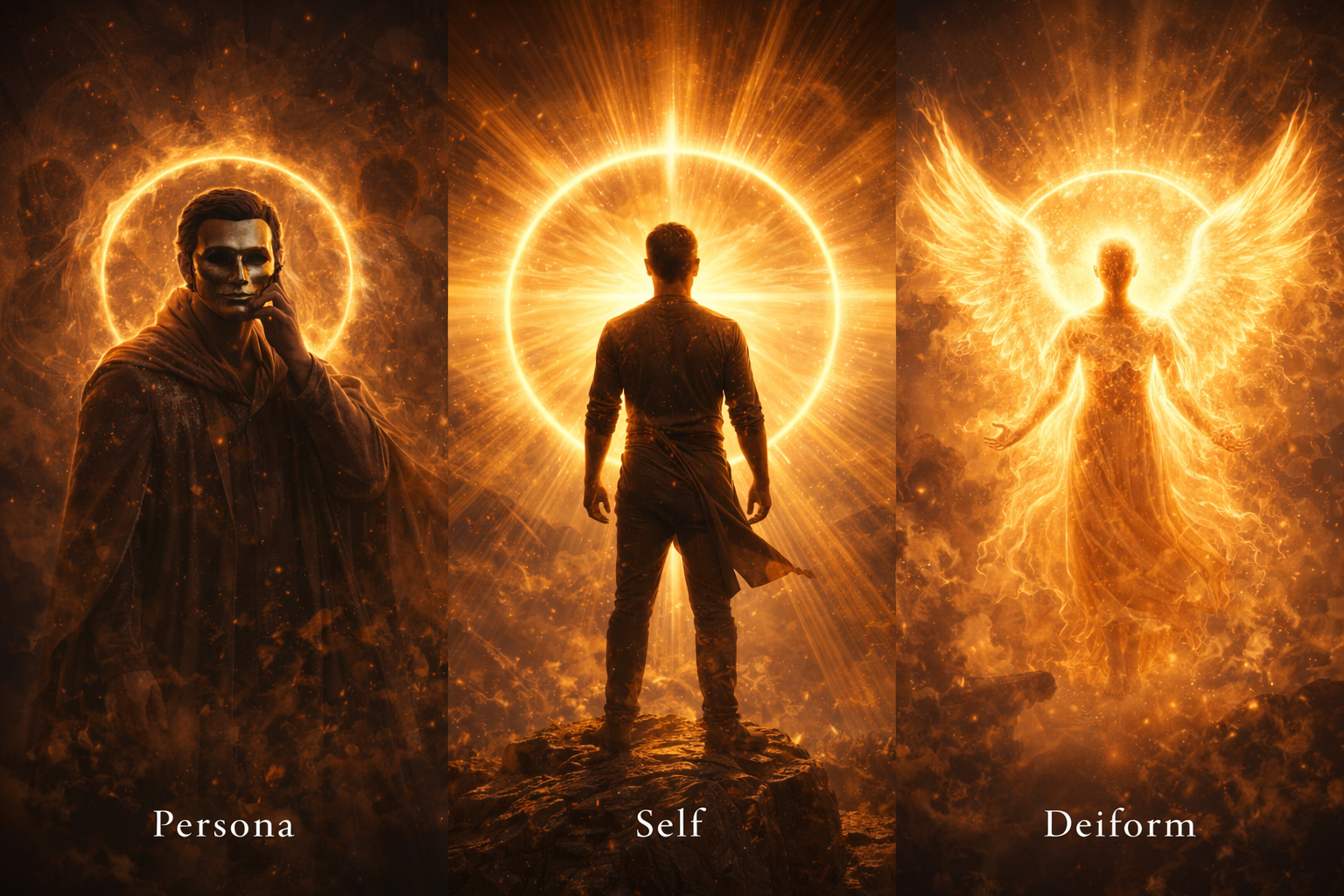
It unfolds through stages, each governed by different archetypal forces. The model I work with—Persona → Self → Deiform—describes orientations of consciousness. (It is what you are oriented toward when you decide, act, and make sense of the world. Inner or outer?)
Each stage has a function. Each becomes limiting when mistaken for the whole.
1. The Persona
The Archetype of Adaptation
The Persona is the social self—the interface between the individual and the world. It is shaped by cultural norms, family expectations, survival needs, and social roles. The Persona allows us to function, belong, and be understood.
Archetypally, the Persona is governed by:
- The Mask
- The Role
- The Servant
- The Performer
At this stage, identity is externally referenced. Meaning is borrowed. Authority is assumed to exist outside the self.
The Persona is not false… it is incomplete.
When a person over-identifies with the Persona, they live reactively. Their sense of self depends on approval, compliance, rebellion, or performance. Thought patterns are shaped primarily by external forces rather than inner clarity.
The Persona’s function is adaptation. Its limitation is dependence.
2. The Self/Individuation
The Archetype of Integration
The Self emerges when a person begins to question the Persona. This is the stage of individuation—the recognition that identity is not reducible to roles, masks, or expectations.
Archetypally, the Self is governed by (the mastered Self):
- The Seeker
- The Witness
- The Integrator
- The Inner Authority
Here, consciousness turns inward. The individual begins to observe their thoughts rather than being governed by them. Inner contradictions are no longer avoided; instead, they are examined. Archetypal forces—such as the hero, the rebel, the victim, the caregiver—are recognized as patterns rather than identities.
This is where self-mastery begins.
The Self is capable of discernment. It can hold tension without collapse. It recognizes that much of what once felt “personal” is actually structural or archetypal.
The Self’s function is coherence. Its limitation is isolation.
Without a higher orienting principle, the Self can become self-referential: trapped in endless introspection, meaning-making, or self-improvement. (Refer to the Kybalion here- everything exists on a spectrum.)
Individuation
(Jung’s term)
Individuation describes the process by which a person becomes psychologically whole.
It involves:
- integrating unconscious material into awareness
- differentiating from the Persona (social mask)
- recognizing and integrating shadow material
- establishing the Self as an organizing center distinct from the ego
Individuation is intrapersonal. It happens within the psyche.
Its aim is coherence and wholeness, not transcendence or moral perfection.
3. The Deiform
The Archetype of Orientation
The Deiform refers to a state of orientation, not belief.
It describes what emerges through and after self-mastery, when a person understands how their inner world works and is able to govern their thoughts, choices, and actions from clarity rather than reaction.
In this state, meaning is no longer borrowed from external authority, impulse, or identity. The individual recognizes patterns shaping both their inner life and the world around them, and responds with discernment rather than compulsion.
The Deiform is not about becoming “divine” or transcending humanity.
It is about becoming oriented—living from inner authority, responsibility, and coherence.
Archetypally, the Deiform is governed by:
- The Sovereign
- The Wise Architect
- The Law-Giver
- The Source
At this stage, meaning is no longer constructed solely from the personal psyche. The individual recognizes pattern, order, and intelligence operating across both inner and outer reality. The macro and the micro are understood as reflections of the same organizing principles. As above, so below.
The Deiform does not override the Self… it stabilizes it.
This is where self-governance becomes possible. Not control, but alignment. Not obedience, but orientation. Action arises from clarity rather than reaction or self-concept.
The Deiform’s function is integration across scales. Its limitation, when misunderstood, is projection.
When mistaken for an external authority, the Deiform collapses back into a Persona-based religion or ideology. When embodied correctly, it restores sovereignty.
An important distinction:
Individuation: “I am whole.”
Deiform: “I am oriented.”
A person can individuate and still:
- remain self-referential
- collapse meaning into personal psychology
- lack a stabilizing principle for ethical or structural governance
Deiform completes what individuation begins by introducing order, orientation, and responsibility without external authority.
Archetypal Flow and Self-Governance
The movement from Persona → Self → Deiform mirrors the transition from unconscious participation to conscious authorship.
- The Persona is governed by archetypes unconsciously.
- The Self recognizes and integrates archetypal forces.
- The Deiform orients those forces toward coherence and responsibility.
This progression allows a person to recognize macro-level governing forces (cultural, symbolic, psychological) and reorganize their micro-level cognition accordingly. Thought becomes clearer, reaction slows, choice expands.
Self-governance is not the absence of archetypes.
It is fluency with them.
This model does not promise transcendence from the world.
It offers literacy within it.
And literacy is power, not over others, but over one’s own perception.
Know thyself.
Glossary
Archetype
A recurring pattern that shapes human perception, behavior, and meaning across cultures and generations.
Deiform
A state of conscious orientation that emerges through and after self-mastery, characterized by inner authority, responsibility, and coherence.
Deiform (Function)
Integration across scales—aligning inner life (micro) with broader patterns and principles (macro).
Deiform (Limitation)
Projection—when mistaken for an external authority rather than embodied orientation.
Individuation
The process of psychological integration through which unconscious material is brought into awareness and the Self becomes distinct from the ego.
Macro
The larger symbolic, cultural, and structural forces shaping collective reality.
Micro
The individual’s inner experience of thought, emotion, and perception.
Orientation of Consciousness
The underlying direction from which a person perceives, interprets, and responds to reality—what organizes meaning, values, and choice.
Persona
The social Self; the adaptive interface between the individual and the world, shaped by roles, expectations, and survival needs.
Persona (Function)
Adaptation—allowing belonging, participation, and social functioning.
Persona (Limitation)
Dependence—identity and meaning remain externally referenced.
Self
The integrated inner center that emerges when identity is no longer defined by roles or external expectation.
Self (Function)
Coherence—inner clarity, discernment, and self-mastery begin.
Self (Limitation)
Isolation—without higher orientation, meaning can collapse into self-referential introspection.
Self-Governance
The capacity to guide one’s thoughts, choices, and actions from clarity rather than reaction.
Listen to the Podcast
This topic is also explored in audio form on the following platforms: